In modern beer dispensing, a metal keg is pressurised with carbon dioxide (CO2) gas or nitrogen (N2) gas or a combination of both. Pressure in the keg drives the beer to the dispensing tap, or faucet.
Pressurised CO2 in the keg's headspace maintains carbonation in the beer. The CO2 pressure varies depending on the amount of CO2 already in the beer and the keg storage temperature. Occasionally the CO2 gas is blended with Nitrogen gas. CO2 / Nitrogen blends are used to allow a higher operating pressure in complex dispense systems.
Nitrogen is used under high pressure when dispensing dry stouts (such as Guinness) and other creamy beers because it displaces CO2 to form a rich tight head and a less carbonated taste. This makes the beer feel smooth on the palate and gives a foamy appearance. Premixed bottled gas for creamy beers is usually 75% Nitrogen and 25% CO2. This premixed gas which only works well with creamy beers is often referred to as Guinness Gas, Beer Gas, or Aligal. Using "Beer Gas" with more common ale and lager styles can cause the last 5% to 10% of the beer in each keg to taste very flat and lifeless.
The gas
system is a very important part of any draft beer
system. The gas system can easily effect both the
taste of the beer and how easy (or difficult) your
draft system is to pour from. All beers have some
CO2 gas dissolved in them. American lagers have
a lot, many micros and imports have very little.
The dissolved gas level of the beer effects the "nose"
of the beer and also the way it feels and tastes in
your mouth. A few beers that are served almost flat
(Guinness is one example) also have nitrogen gas dissolved
in them so they will have special head characteristics. 
When you are using CO2 to dispense beer the beer is
sensitive to picking up too much gas (over carbonation),
and also loosing gas (going flat). Whatever gas you
are using, it always comes into contact with the beer
in the keg. The gas entering the keg pushes down on
the beer forcing it up a tube and out into the draft
system. When using CO2 there is little room for error
in deciding how much pressure is needed in the keg.
If the temperature of the beer raises 2 degrees, one
more pound of pressure is needed. If the temperature
of the beer drops 2 degrees, the pressure in the keg
needs to be reduced by one pound. Different brands
of beer also need different amounts of pressure. For
example at 36 degrees, Coors needs 15 PSI, Budweiser
needs 12 PSI, Killians Lager needs 13 PSI, and Bass
Ale needs 9 PSI. If the pressure is more than 2 PSI
out of calibration the carbonation level of the beer
will change causing off taste, pouring problems, or
both. You should never adjust the beer's gauge pressure
to control the flow rate of the beer. The flow rate
is controlled by adjusting the length of the beer
line.
Pouring problems result when beer goes flat while
in the lines or a keg is exposed to too much pressure
for too long. These problems can be cured by having
enough secondary regulators to run each beer at its
ideal gauge pressure and being careful to store the
beer at an even temperature.
Order Standard / Premium Kegerator Conversion Kit Here!
Low Pressure – KEG BEER CONVERSION KITS
If your beer is going flat while in the lines it is
caused by the pressure being set too low. It will
be obvious to you 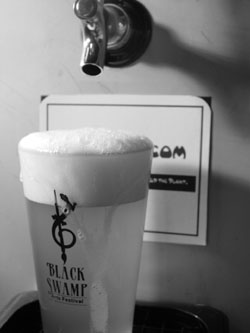 because
the beer line will collect pockets of CO2 gas.
because
the beer line will collect pockets of CO2 gas.
These pockets of gas will be worse the longer you
go between uses of the tap. They will also be worse
when the keg has a lot of beer in it because as the
gas breaks out of the beer, it will eventually become
flat enough that the problem will stop. You will usually
experience this problem during at least the first
half of the keg. The pockets of gas collect right
above the keg and directly behind the faucet, therefore
when you open the faucet you will get a shot of foam,
about 4 ounces of clear beer, followed by another
shot of foam. After which the beer will pour clear
until the tap is at rest for 10 minutes or so, allowing
the gas pockets to build up again. Remember that as
the temperature of the beer increases, it will require
more pressure so these same symptoms will occur if
the kegerator or beer is more than 4 degrees higher
than what the pressure was set for. This is why it
is important to keep the beer at a constant temperature.
Whether you are using a keg box or a walk in cooler
it is important to keep the door closed so that the
keg temperature does not fluctuate. If you are using
a keg box it is not wise to store garnishes, tomato
juice, or liquor bottles in the cooler that would
require you to open the door frequently. Gas will
also break out of the beer behind the faucet if the
dispense tower is not cooled properly. There should
be some sort of way set up to force cool air into
the tower. If the tower is not cooled properly it
can also cause the section of line in the tower to
build up a lot of yeast growth. No matter how often
you have your beer lines cleaned this build up due
to warm lines will cause problems with foul tasting
beer.
High Pressure - KEG BEER CONVERSION KITS
If your
keg is exposed to too much pressure or is on line
for too long you will experience problems caused by
over carbonation. Over carbonation symptoms appear
when the carbonation level of the beer increases because
the pressure is set too high.
Mild over carbonation symptoms usually closely resemble
those caused by beer going flat in the lines. The
difference is that they will appear when the keg is
nearly empty (the last 1/3 or so). Remember that as
the temperature of the beer drops, it needs less pressure
to maintain the proper carbonation level. Therefore,
you may see these problems if your beer is stored
on line at temperatures less than 35 degrees. The
ideal temperature range for keg storage is 35 to 40
degrees.
If you
are interested in a kegerator
conversion kit please click here.
Homebrew
Kegerators
Beer Meister
Refrigerator
How To
Build a Keg Fridge

